


News

Share
Published 15:45 14 Sept 2026 BST
Updated 17:40 14 Sept 2026 BST
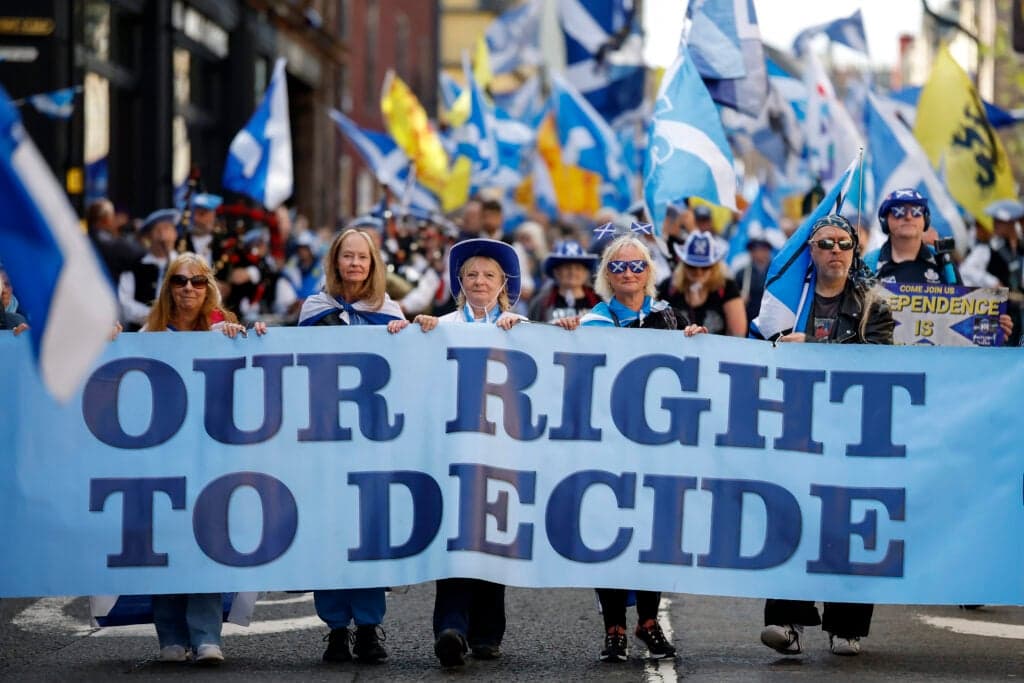
Lots of questions are rising over the ongoing talks between Scotland, Northern Ireland and Wales in a potential break of the United Kingdom as we know it.
This comes as leaders from all three countries have signed an agreement of cooperation in Cardiff, on Monday, calling on their “right to self-determination”.
Leaders from the Scottish National Party, Sinn Féin and Plaid Cymru have called on the UK to “prepare for, plan and facilitate constitutional change in each jurisdiction.
There are many points to go through, with many moving pieces as the events are currently unfolding.
First of all, all three nations share similar agendas in demanding fairer economies and more flexible energy resources to the UK.
All three parties have also expressed strong feelings of rejoining the European Union.
With an overwhelming consensus favouring a referendum in Scotland, it feels like we’re closer than ever to see the UK’s first break away state.
But let’s be honest, it is all a bit more complicated than bidding farewell and waving to your neighbors from across the border.
This article will reflect on the possible outcomes of each country’s call to independence from the UK and what it would mean for England as a whole.
Scotland has been seen as a frontrunner for independence, holding their last referendum in 2014, with a little over 55% in favour to remain within the Union.
John Swinney, the Scottish First Minister has also been a leading voice for Scottish independence for some time.
Wales, although less prominent, still shows a strong favour towards independence.
Between 25 to 32 per cent of Welsh voters are said to be in favour of independence, which wouldn’t be sufficient to part ways but enough to ask for more self governance and economic freedom.
Northern Ireland is a special one, as its call to break away from the UK wouldn’t particularly end with independence.
Rising talks in the Republic of Ireland over the Good Friday Agreement have come up after Andy Burnham’s Belfast visit in August.
Burnham said that a border poll was “off the table”, to which he came back on his words after some backlash.
Donald Trump also shared his opinion over Irish Unity, supporting the idea as he announced stripping tariffs on Irish exported whiskey.
As you may see, despite sharing the same agenda in leaving the Union, all three countries have very different paths ahead if they were to detach themselves.
Wales, currently the least likely to depart, does not have a currency solution and is severely tied to the British pound.
However, Scotland has been sitting on this one for some time now.
If the neighbours in the north were to gain independence, the country would still operate with the British pound, as no regulations would ban them from doing so.
The Scottish National Party (SNP) however has thought out a solution to eventually introduce the Scottish pound.
But switching to your own national currency doesn’t necessarily equal to financial growth as the country is slowly stagnating.
Scotland has also raised its voice on rejoining the EU, however this time as an independent country.
Northern Ireland on the other hand faces a completely different outcome, as an Irish Unity would mean the direct absorption into the EU and use of the euro.
In England, the pound would remain relatively unchanged. In fact, the country would gain substantially from a Union split.
The Institution of Fiscal Studies (IFS) reported 10.9% of Scotland’s GDP comes in fiscal benefits, compared to the UK’s 4.2% as a whole.
On paper, this would mean that England would become 6.7% richer if Scotland were to breakaway. But again it is not that simple.
All countries within the UK are deeply economically tied to each other, and adding barriers to these ties wouldn’t be beneficial for any of them financially.
In this scenario where the partition of all, or most countries from the UK actually happens, England would be left with a lot of paper work on the table.
To start, England would have to recognize that the Union is voluntary, and would have to concede the decision of its foreign constituencies.
If Scotland and Wales were to potentially join the EU, heavy border controls might be applied throughout on the island of Great Britain.
However, it is more likely that there would be a free travel agreement between the nations, much like what is in place at the moment between the UK and Ireland.
A lot of the country’s economic development relies on these infrastructures, from freight, tourism, energy, trade, universities, and the big one, geopolitical influence.
On the other hand, a smaller UK means that England gains a greater fiscal concentration and more homogeneity within the political system, meaning less problems for London to deal with.
However, the real question is: Would a UK breakup replace one political problem with four smaller ones?
Most notably would can argue that changes will be more noticeable culturally. How would Scotland Vs England games play out? Would Burnham go down as a hero, or a zero? Would we see economic cooperation, or competition within the isles?
Explore more on these topics:

News

News

News

Harry Potter star says private schools should be ‘burnt to the ground’
Johnny Flynn says therapy helped him understand his boarding school trauma Johnny Flynn has spoken candidly about the lasting impact of his time at boarding school, describing the experience as traumatic and taking a strong stance against private education. The actor, known for the Channel 4 sitcom Lovesick, previously titled Scrotal Recall, and the 2020 […]
News
49 min
All the stars who have backed Macklemore after being dropped from Ed Sheeran tour for Free Palestine speech
Macklemore has refused to let his tour removal silence him Macklemore has been backed by a number of high-profile celebrities after being removed from Ed Sheeran’s US tour over his pro-Palestinian statements. The rapper, whose real name is Benjamin Haggerty, had been performing as the opening act on Sheeran’s Loop tour. That changed after he […]
News
1h
News
Should Burnham have a seat at the table over Celtic Alliance talks?
News


